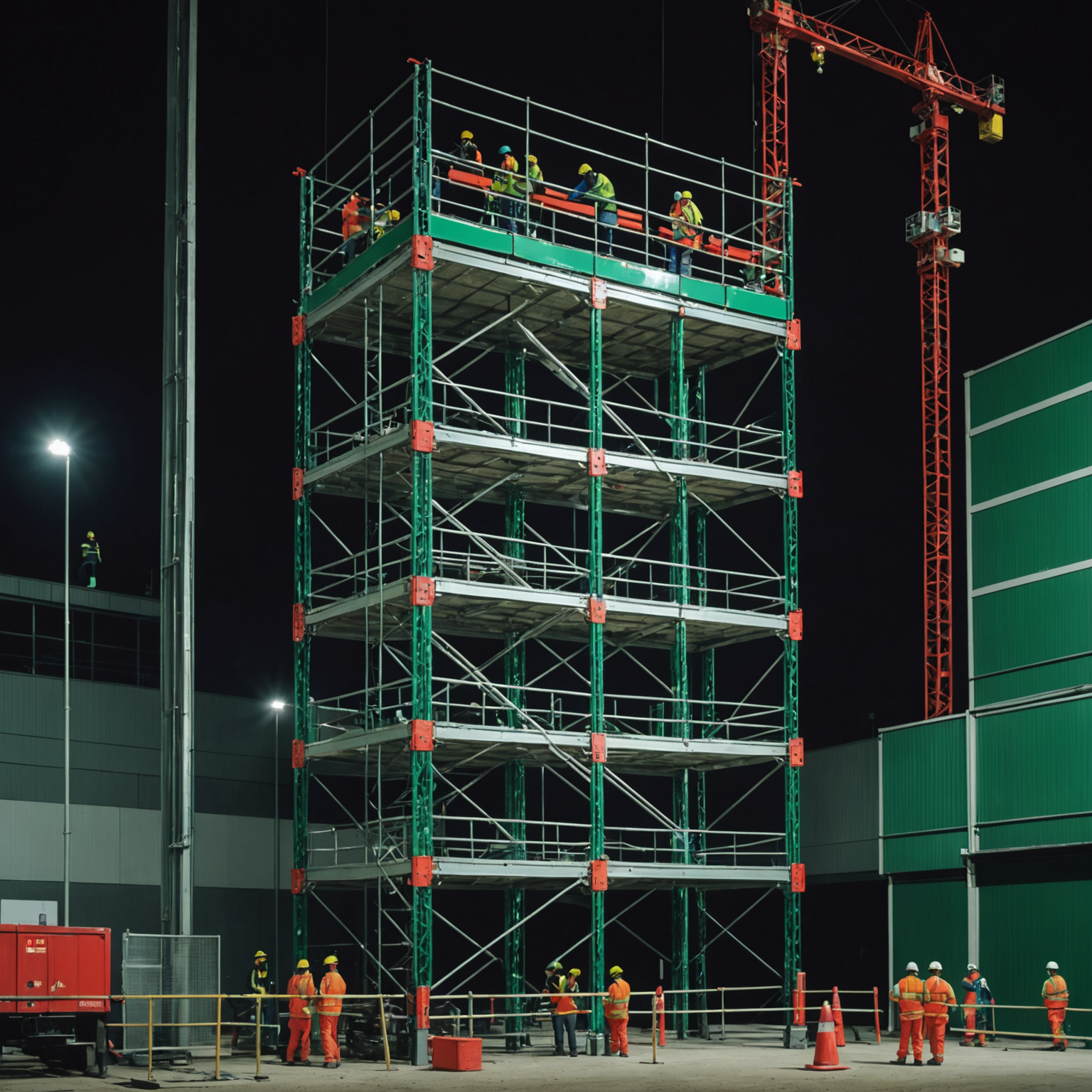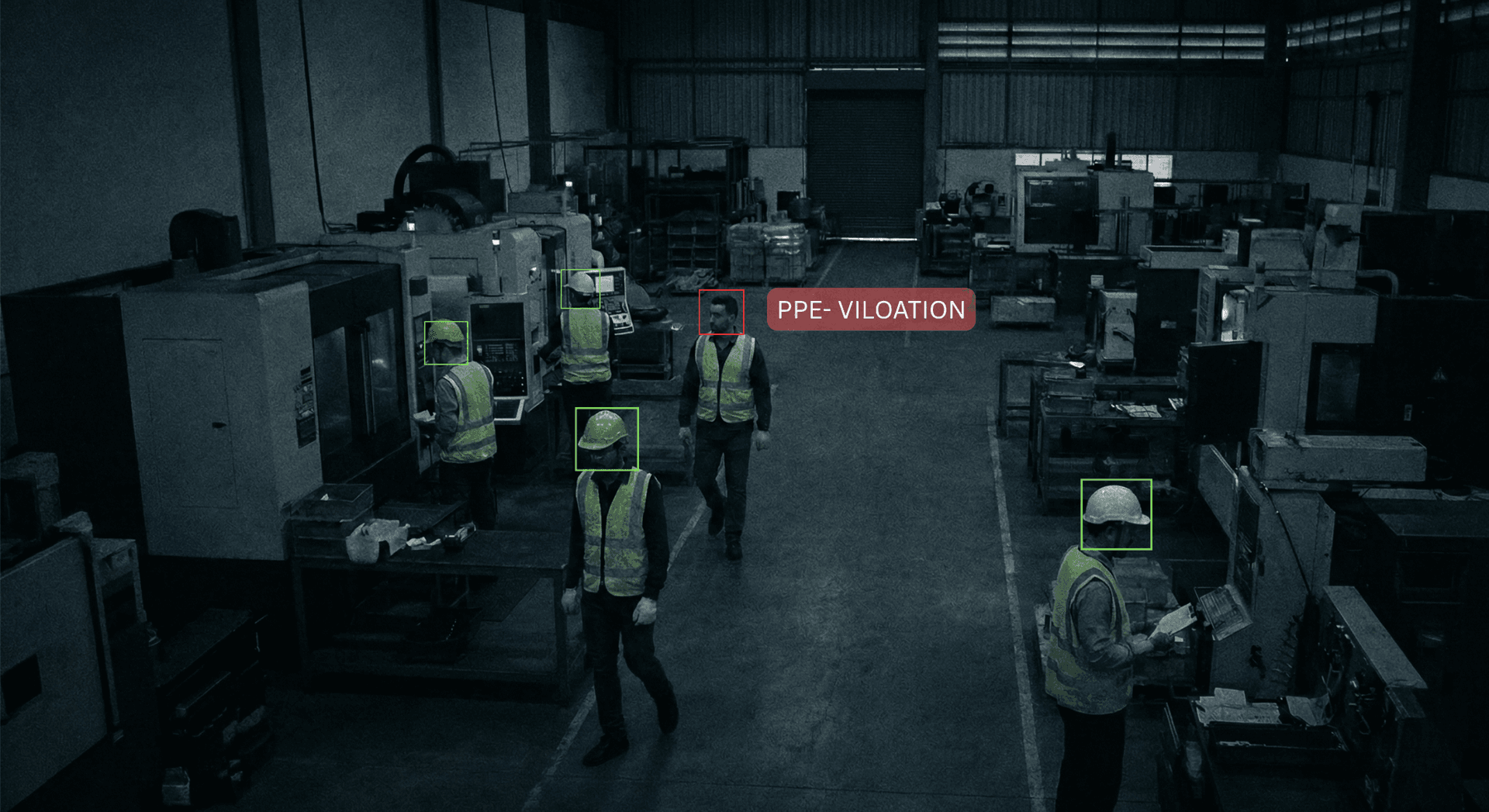
Why Aramco contractor PPE has its own playbook
Generic PPE models trained on European construction footage underperform on Aramco contractor sites for three predictable reasons. First, the dominant garment is the orange or navy flame-resistant coverall (FRC), not a separate hi-vis vest, so vest classes misfire. Second, summer glare from sand and concrete pushes camera auto-exposure into clipping, which collapses helmet contrast. Third, contractor headcounts at large turnarounds easily exceed 4,000 workers across multiple gates, so a 2% false-positive rate produces hundreds of nuisance alerts per shift and trains supervisors to ignore the system.
A 2026-ready deployment plans for those three realities from day one. The rest of this guide walks through the field decisions in order.
1. Map the PPE classes Aramco actually inspects
Before training data is touched, align the class list with the contractor HSE manual and the SAP Permit-to-Work (PTW) categories. A defensible minimum class list looks like:
- Hard hat (worn / not worn)
- FRC coverall (worn / partial / absent)
- Safety glasses (worn / not worn)
- High-visibility outer layer over FRC (required at night and inside roadways)
- Gloves (task-conditional, often optional in the model)
- Fall-arrest harness (only when work-at-height permit is active)
Tie each class to the PPE detection solution and to the work-at-height workflow so that model output maps cleanly onto inspection checklists rather than onto generic “violation” buckets.
2. Pick a model that survives Saudi summer light
For 2026, a finetuned YOLO-class detector on a Hailo-8 or Jetson Orin NX is the dependable baseline. Foundation-model pipelines such as Grounding DINO plus SAM 2 produce stronger zero-shot results but are not yet cost-effective for 24/7 contractor-gate monitoring at the scale of an Aramco facility.
Recommended starting points:
- Detector: YOLO26-m or RF-DETR-base, finetuned on at least 8,000 KSA-sourced frames covering daylight, dusk, sodium-vapor night light, and dust events.
- Backbone augmentation: heavy gamma jitter (0.6–1.6), HSV-S +/-30, Mosaic with desert-background sampling, and CutMix between FRC and bare-coverall classes.
- Hard-negative mining: sample of cleaning rags, orange traffic barriers, and orange site cones — each of these triggers naive vest classifiers.
Pair the detector with a Smart Monitoring Platform that handles streaming inference, event deduplication, and the SAP hand-off described later.
3. Set IoU and confidence thresholds with intent
Default thresholds shipped by model zoos optimise for COCO-style mAP, not for HSE outcomes. Tune by class:
| Class | IoU | Confidence | Rationale |
|---|---|---|---|
| Hard hat | 0.50 | 0.65 | Small object, high cost of false positive (worker pulled off task) |
| FRC coverall | 0.45 | 0.60 | Large object, often partially occluded by tools |
| Safety glasses | 0.40 | 0.55 | Very small object, accept lower IoU but verify with face crop |
| Hi-vis outer | 0.50 | 0.60 | Confusable with FRC orange, requires reflective-stripe feature |
| Harness | 0.45 | 0.70 | High-risk class, raise confidence to avoid permit drama |
These are starting values; rerun on local validation and freeze only after the false-positive review process below.
4. Handle FRC properly — it is not a vest
The single biggest model failure on Aramco sites is treating FRC as interchangeable with a hi-vis vest. They are not interchangeable, and HSE auditors will reject any system that conflates them.
Two engineering patterns work:
- Two-class FRC head: FRC-with-reflective-stripes vs FRC-plain. Many Aramco operating sites require the reflective-stripe variant during night shifts and in roadway zones; a plain FRC is a violation in those contexts even though the worker is technically in a coverall.
- Garment-segmentation auxiliary: a SAM 2 mask over the torso region that feeds a second classifier for stripe detection. More accurate, more compute, justifiable on permit-critical zones.
Document both choices in the trust and audit overview so HSE can review the design before approving.
5. Throttle false positives or lose the room
Three rules cut nuisance alerts by roughly an order of magnitude in field deployments and are what experienced KSA HSE managers expect to see in the design doc:
- 3-frame persistence: a violation is only emitted if the same worker-track holds the violation for at least three consecutive frames at 5 fps. This kills momentary helmet-strap-adjust events.
- Zone gating: PPE rules are evaluated per zone, not per camera. Hard-hat is mandatory in process units, optional in air-conditioned admin trailers. Tie zones to the perimeter and zone monitoring layer.
- Permit-aware suppression: when a hot-work or confined-space permit is open in SAP-PM, the system raises the harness threshold and suppresses redundant violations from the same worker for the duration of the permit task.
6. Wire the events into SAP-PM, not into a side database
The deliverable that wins the contractor audit is not a dashboard. It is a notification in SAP Plant Maintenance referencing the work order, the functional location, and the contractor company. Recommended hand-off:
- Each detected violation produces a JSON event with:
event_id,timestamp_utc,camera_id,zone_id,class,confidence,worker_track_id,clip_hash,permit_id(if any). - A middleware service (typically a Node or Python adapter) calls the SAP OData endpoint
BAPI_ALM_NOTIF_CREATEwith notification type Y2 (Aramco contractor HSE) — confirm the exact type with your contracting officer, as it varies by operating organisation. - The clip hash points at WORM storage; the SAP notification carries the URL but never the clip itself, so PDPL retention rules stay enforceable.
- Closure of the SAP notification feeds back to the analytics layer to mark the event as
actioned.
For deeper integration patterns see the AI analytics platform and the API access overview.
7. Build the audit evidence trail before go-live
Aramco contractor audits in 2026 expect, at minimum:
- A model card with training-set demographics, class balance, and validation precision/recall per class.
- A drift log showing weekly precision on a held-out KSA validation set; drop below 0.85 triggers retrain.
- A tamper-evident clip store with SHA-256 hashes signed daily.
- A DPO sign-off referencing the PDPL compliance posture and the lawful basis for processing worker images on contractor sites.
Skipping any of these does not stop the system from running; it stops the system from being usable as evidence in a contractor incident review.
8. Field deployment checklist
Use this as the pre-mobilisation gate:
- PPE class list signed off by contractor HSE manager.
- Cameras commissioned with sun-angle survey for July glare worst-case.
- Edge devices (Hailo-8 or Jetson Orin NX) imaged with the validated model build hash.
- SAP-PM notification type confirmed with contracting officer.
- Permit-to-Work integration tested end-to-end with at least one hot-work and one work-at-height permit.
- DPO and HSE jointly sign the deployment record.
- First two weeks run in shadow mode — events logged but not escalated — to calibrate thresholds.
Next steps
If you are scoping a 2026 PPE deployment on an Aramco contractor site, start with our PPE detection solution, review the construction safety overview, and benchmark against the Vision 2030 construction technology context. For procurement reality, see the companion guide on IKTVA and Saudi-Made AI vendors.
Book a contractor-site assessment and we will produce a site-specific PPE class list and threshold plan within 10 working days.