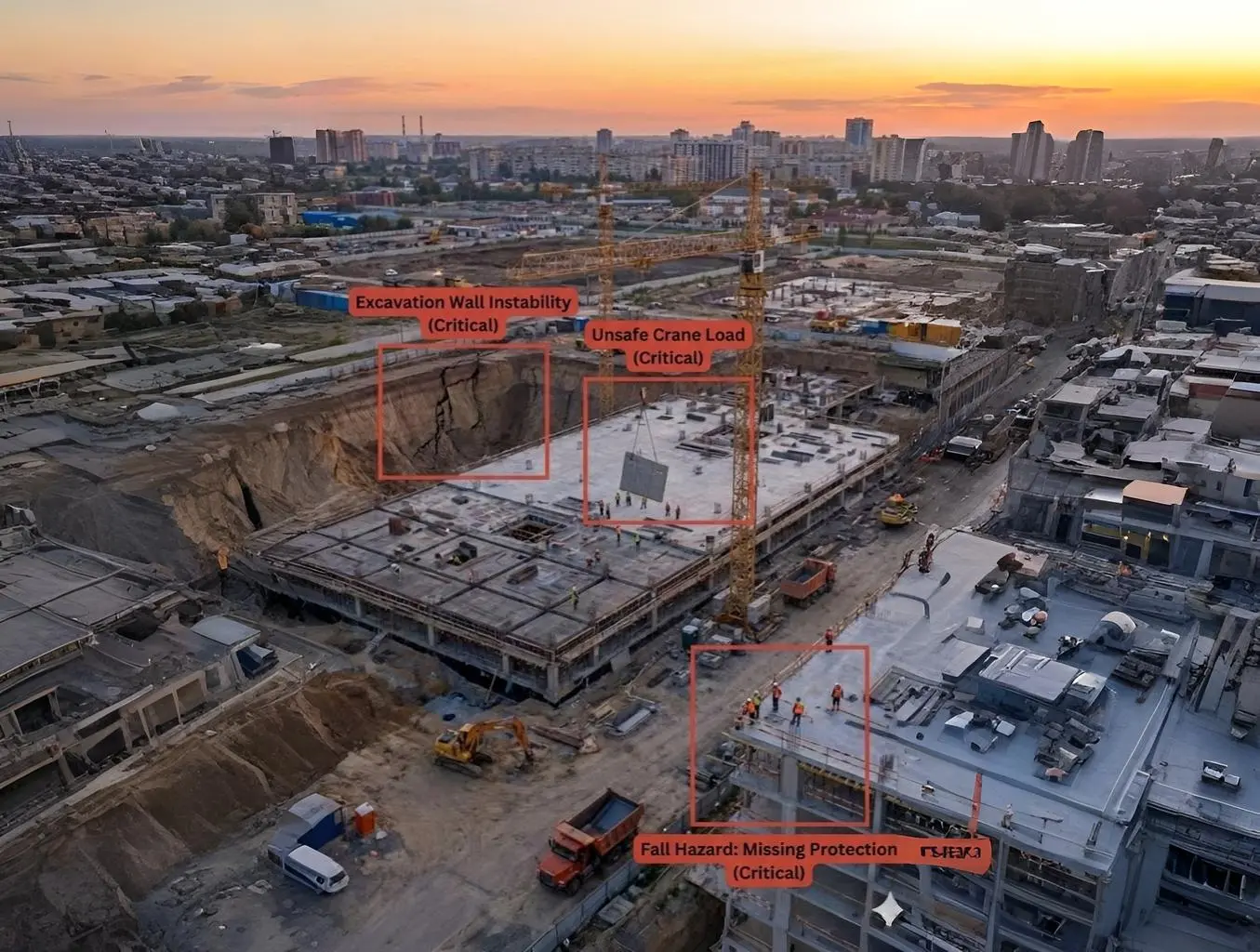
Why mega-project perimeters are different
Three factors break standard perimeter products:
- Length. Trojena alone has a 60-km construction perimeter; The Line is 170 km long. Off-the-shelf “smart fence” products are priced for kilometres, not hundreds of kilometres.
- Heterogeneous boundary. NEOM mixes alpine, desert and coastal; Red Sea Global has island and reef perimeters; Diriyah is heritage-dense urban. One product cannot cover all three.
- Workforce density. Tens of thousands of legitimate workers cross the perimeter daily. Distinguishing legitimate from intrusive movement is the dominant ML problem.
Three perimeter zones to design separately
A defensible 2026 architecture splits the perimeter into:
- Hard zone: outer fence and security cordon. High-sensitivity, no expected legitimate traffic outside designated gates.
- Soft zone: contractor logistics yards, lay-down areas. Workers and vehicles legitimate during working hours; intrusion is an after-hours problem.
- Heritage / sensitive zone: at Diriyah, archaeological boundary; at Red Sea, reef-protection boundary. Intrusion is not just a security event but an environmental compliance event.
Each zone gets a different sensitivity profile, a different alert path and a different retention policy.
The technology stack
A 2026 stack:
| Layer | Hardware |
|---|---|
| Fixed cameras at gates and pinch points | IP PTZ + fixed wide-angle |
| Mast cameras at long-perimeter intervals | 25–35 m masts, 360° coverage |
| Drone overflight on schedule | Matrice 4 or M30T fleet, GACA Class 1 standing permits |
| BVLOS surveillance for The Line corridor | See the BVLOS permits piece |
| Edge inference per cluster | Hailo-8 or Jetson Orin NX |
| Site server | DGX Spark or A30 partition |
| KSA-resident region | CST-licensed cloud |
For the underlying solutions see perimeter monitoring and intrusion detection.
False-positive control
A 200 km perimeter at 0.5% per-frame false-positive rate produces tens of thousands of nuisance alerts per day. Three controls:
- Multi-frame persistence. Intrusion only fires after 3+ frames at 5 fps, on a track that crosses a defined boundary, not just enters a frame.
- Identity gating. Workers with active permits pass through soft-zone boundaries without alarm.
- Animal class suppression. KSA perimeters see camels, foxes, dogs and birds; the model has explicit non-human classes that suppress.
- Environmental gating. Storm-condition fallback per the dust + haze piece prevents the system from screaming during weather events.
After tuning, a well-designed 2026 system on a 100 km perimeter typically reports 10–30 alerts per day, not thousands.
Integration with the security operations centre
The deliverable that operations teams accept is a single feed in the existing SOC, not yet another dashboard. Integration patterns:
- VMS overlay — alerts appear inside the existing SOC video wall via Hikvision, Bosch BVMS, Genetec, Milestone, Hanwha or Axis integrations.
- PSIM bridge — for sites running a physical security information management platform.
- Direct-to-radio escalation — high-severity alerts trigger radio dispatch.
- Aggregate analytics — AI analytics platform for trend reports.
PDPL posture for mega-project perimeter
A perimeter system processing footage of legitimate workers and visitors triggers PDPL processing requirements. The defensible posture:
- Lawful basis — security and asset protection, documented per zone.
- Face-blurring at the edge for non-incident frames.
- Retention — 14 days for non-incident clips, 90+ days for confirmed intrusion events.
- Cross-border posture — KSA-resident processing, anchored in the data residency posture.
- DPO sign-off, anchored in the PDPL compliance checklist.
Where each mega-project needs a different design
- NEOM Trojena: alpine. Snow on cameras and on intruders changes silhouettes; cold-weather edge boxes required.
- NEOM The Line: linear. The 170 km corridor is too long for fence sensors; a drone-and-mast pattern dominates. See the NEOM monitoring piece.
- NEOM Oxagon: coastal. Salt spray accelerates camera failure; IP66 minimum and 12-month rotation.
- Diriyah: heritage urban. The boundary is dense and irregular; many small camera clusters rather than long sightlines.
- Red Sea Global: island and reef. Boundary is partly maritime; waterborne intrusion needs a marine vision profile.
- Qiddiya: greenfield development. Standard mega-project perimeter pattern works well [VERIFY-SME].
Drone overflight as a perimeter layer
A drone layer extends the perimeter cost-effectively:
- Scheduled overflight every 4–8 hours along defined corridors.
- On-demand response to camera-triggered alerts in the soft zone.
- BVLOS night sweeps for hot-zone monitoring under GACA BVLOS permits.
The drone fleet typically costs 30–50% less than equivalent mast-camera coverage of a long perimeter [VERIFY-SME].
Cost envelope
Indicative SAR for a 100 km mega-project perimeter, 2026:
| Item | SAR per year |
|---|---|
| 80 fixed cameras at gates and pinch points | 280,000–650,000 |
| 24 mast cameras at long-perimeter intervals | 480,000–860,000 |
| Drone overflight programme | 380,000–680,000 |
| BVLOS for linear corridors | 180,000–420,000 |
| Edge inference and site servers | 320,000–520,000 |
| Software licence | 380,000–620,000 |
| SOC integration | 280,000–520,000 (Year 1) |
| Year 1 total | 2.3M–4.3M |
[VERIFY-SME for project-specific configuration.]
Common deployment mistakes
- One sensitivity for the whole perimeter — produces noise in soft zones and misses in hard zones.
- No animal-class suppression.
- No drone layer — fixed cameras alone leave gaps.
- No PDPL DPO sign-off.
- No environmental fallback — storms produce false-alert floods.
Field deployment checklist
- Per-zone sensitivity profiles signed off.
- Animal-class suppression active.
- Drone layer scheduled and permitted.
- SOC integration tested.
- PDPL DPO sign-off and retention schedule in force.
- Two-week shadow mode at start.
Next steps
If you are scoping perimeter and intrusion detection on a Saudi mega-project, start with the perimeter monitoring solution, the intrusion detection solution and the NEOM monitoring piece. Cross-reference the GACA BVLOS permits piece, the face recognition + PDPL piece and the edge vs cloud piece.
Book a mega-project perimeter scoping call and we will produce a per-zone design and SOC integration plan within 15 working days.